

SEMINARS
Latin American Percussion seminar
The seminar will be a thorough and systematic presentation of rhythms and rhythm instruments from Cuba - and possibly Brazil.
The various playing-techniques will be demonstrated and rehearsed, and the rhythms will be gradually build up. Phonetichs (vocal percussion) and traditional songs will be an important part of this process.
We will work with styles like rumba, son montuno, cha-cha-chá, bolero, mambo/guaracha and Afro Cuban 6/8.
Since the congadrum is such an important instrument in this music, a great deal of time will be used on rehearsing this instrument.
Other important instruments of the seminar will be: bongos, cow-bell, timbales, claves, maracas and guiro.
If we work with Brazilien styles, it will be rhythms like: samba moderno, samba batucada, bossa nova, and baion. Instruments will be: Surdo, ganza, reco-reco, tamborim, ago-gô, conga/atabaque, triangel, cabasa a.o..
Another requirement can be the use of various percussion-instruments in fusion with e.g. rock- and jazz.styles (See also the conga seminar below).
No prior knowledge of the rhythms or instruments is required to attend these seminars. - And, nobody becomes a percussionist in one seminar.
It is important that the rhythms function - not the amount we can manage.
The contents and structure will of course, be tailored after the level and special wishes for each seminar
Conga seminar
This seminar is based on the book and CD combination:
Congas • Tumbadoras
– Your basic conga repertoire
– From Cuban music and Salsa to Rock, Jazz and Samba.
A very popular seminar since the conga drum today is one of the most popular percussion instruments.
Just like the book this seminar is building up step by step starting with the basic strokes. You will learn to play the most well known Cuban styles and techniques and discover how to use these rhythms in fusion with other music styles.
In addition we will work on other basic rhythms, for instance: samba, rock, soul and jazz.
The seminar will help you to achieve technical and musical versatility, giving you the ability to compose your own conga rhythms and the freedom to choose your own style of playing.
During the seminar we will make frequent use of the phonetic sounds of the rhythms.
No prior knowledge of the rhythms or instruments is required to attend this seminar. - And, nobody becomes a percussionist on one seminar.
The contents and structure will of course, be tailored after the level and special wishes for each seminar
It is important that the rhythms function - not the amount we can manage.
More advanced studies
Any wish for a seminar at a higher level or working with specific rhythms or musical styles is welcome.
The main idea with the book Congas • Tumbadoras is to help you to achieve technical and musical versatility and get an all-round conga repertoire. You decide the level yourself!
The seminar can also include the use of other percussion instruments and building up a musical group including piano, bass, vocals etc..
The Little Conga Book (2013) can also be the material for a basic conga seminar, for example as an introduction for “Drum Circles” etc,
Drum Circles - drum groups
Are you attracted by the power and energy of the drum?
Here is your chance to get a very special musical experience. Beginners as well as experienced players!
We play congas and other drums (mainly hand-drums). Some Latin American and African percussion might also be included.
In a drum-circle the goal is not to play arrangements, but to keep - and enjoy - a beautiful and swinging rhythm. And to make it better and better the more we play.
During the seminar I will teach some basic rhythmic training and make use of the phonetics - the vocal interpretation of the instruments.
We will always be several people on similar instruments, so the beginner will always find a supporting person near by!
We play - and play - and play - at our own level!
Everybody is welcome. Everybody can join in!
Feed the musical part of you and charge yourself with both physical as well as mental energy!
“Night Rumba”
We make the "Night Rumba" to understand the importance of even the most so-called "simple" rhythms.
Each person is given an instrument, such as the tumbadora (basic rhythm), tres golps or conga (secondary conga rhythm), claves, and stiks (cascara/palitos - rhythm played on the sides of a conga or on a chair). Now and then we add a simple vocal chorus (coro).
There are no limits to the number of people playing and I start out presenting and rehearsing the basic rhythms for each instrument. When the group starts to function, I turn out the light and the rumba (guaguancó) is played non-stop for 1,5 to 3 hours depending on the situation
Playing in the dark makes everybody relax in a beautiful way. They are able to concentrate and after a while start to (be able to) hear what the other instruments are playing, which little by little makes the rhythm more tight and swinging. The only thing you have to do is to keep on playing - and enjoy.
You will feel a beautiful tranquillity during and after this session. And you will realize how great it is to play even the most so-called "simple" rhythms for a long time - it becomes music
Salsa band
The seminar pressented here, can be anything from very basic to advanced level. This is your choice!
Salsa is Cuban music that through the years has got inspired by elements from South America, the Caribbean islands and USA. All the countries in South America and the Caribbean have their own folk music, but the salsa has become a kind of their common language.
The salsa has for many years now become popular through out the whole world and is in very famous for giving inspiration to other music styles as well.
Basic in salsa, and very important, is a strong percussion section with congas, bongos, timbales, maracas, guiro, claves and at times a drumkit. All this in a close teamwork with the bass, piano and at times a guitar.
A lead singer and a chorus is important and in most types of orchestra a horn section is also taking part. Even strings are used.
At this seminar, we will build up the arrangements gradually from the most basic elements, and the vocal themes and choruses (coros).
You will get to know all the building blocks of the salsa and the relationship of all elements.
To be part of this group you need to be able to read (slow) and manage to play your instrument.
We will often be several people on similar instruments (also piano and bass), so the beginner will always find a supporting person near by!
Most percussionists will be able to manage without reading, but you have to be able to count the bars. Of course you need to be able to play the most basic rhythms - eventually by following a corresponding class.
Notice! In this group we do not (unless planned ...) talk theory of education. Here we behave like musicians - which means that we play and play and play - on our level!
Rhythmic training - "From head to body"
"From head to body" is basic rhythmic training, by the use of clapping rhythms, phonetics, co-ordination exercises and much more.
Phonetics (vocal-percussion) is a natural part of all elements of the rhythmic training. It is used when practicing rhythms before eventual percussion instruments are taken into use, and also works as your own "accompaniment" when clapping rhythms and rehearse the movements of the body.
"From head to body" is training, development and becoming aware of your own rhythmic sensitivity and skill. It is tuning yourself rhythmically, so to speak.
Exercises will include: pulse, timing, dynamics, period and co-ordination.
The contents and structure will of course, be tailored after the level and special wishes for each seminar.
In some groups stretching and warming up will be part of the seminar.
In other groups Salsa dancing will be a part of the seminar.
From Columbus to Salsa
A living lecture on Cuban music
The lecture is taking it's starting point in the part of the Cuban music music history that have given birth to the popular music of Cuba that we know today: Salsa, cha-cha-chá, son, mambo, rumba and many more.
Many people have become familiar with groups such as Buena Vista Social Club and Afro Cuban All Stars, but there are many less famous artists that have similar importance for the world wide prevalence of this great music.
Birger Sulsbrück is performing in three different "roles" during the lecture.
1) The storyteller with his manuscript, giving short facts and comments to various periods of
the Cuban music history
2) The musician, presenting the various Cuban rhythm instruments as they appear in the
musical examples.
3) The student/the research worker, telling about both beautiful and droll episodes from his
many travels to Cuba (and New York) - Like the first dance lesson and the first koncert
with his own Danish salsa band in 1983 in front of 50.000 people.
We will hear original recordings of styles such as habanera, son and danzón. And we will hear various types of orchestra, such as Orquesta Típica, Charanga Francesa, Jazz Band Cubana (Banda), Son Sexteto and Son Conjunto
We also have time for a short trip to New York, where we will meet the mambo and "The King of Salsa" Tito Puente and the record company Fania.
We end up with the music of today from both Cuba and New York - and also hear and realize how different they are.
Birger Sulsbrück has been working with Cuban music during the last 30 years. He started Denmark's first salsa band, Salsa Na Ma, in 1979.
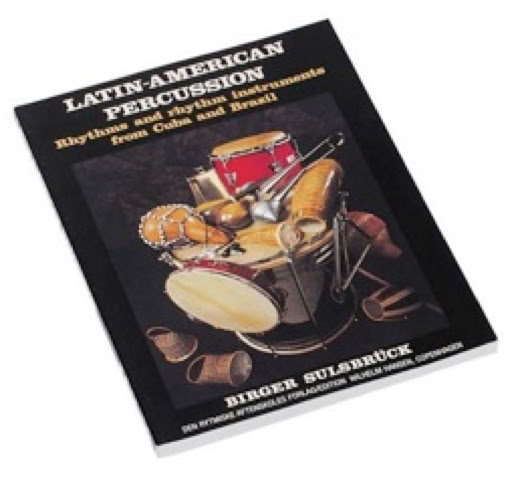
The band has been touring two times in Cuba. He is teaching and has released guide books and videos such as "Latin American Percussion - Rythmes and rythminstruments from Cuba and Brazil". (1985). Printed in Danish, English and German and is distributed globally.
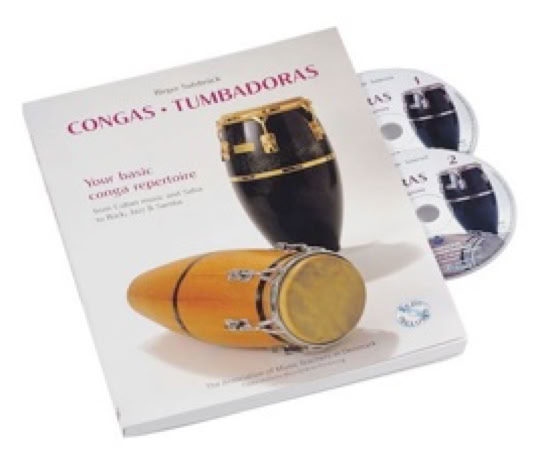
144 pages and two CDs

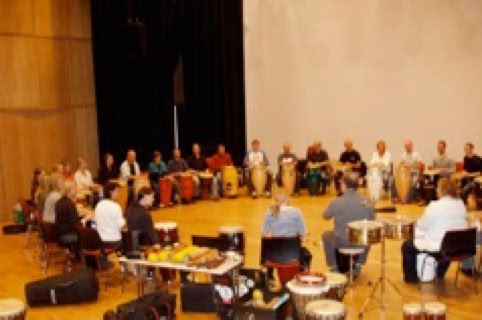
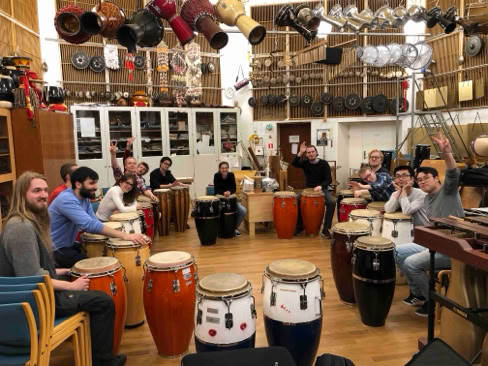
Drum Circles in Royal College of Music, Copenhagen. 2: Oslo, Norway
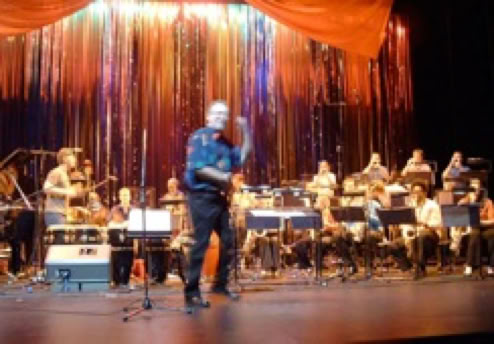
RNCM Big Band, Manchester
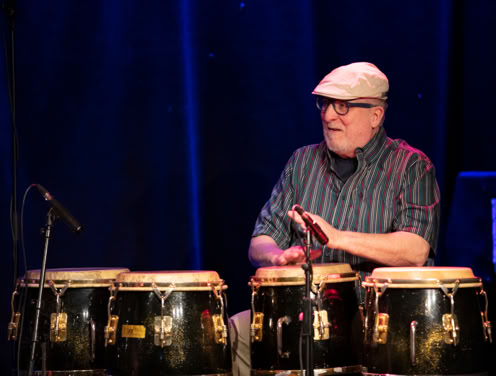
138 free audio tracks on the DOWNLOAD page
44 pages and one CD
- for getting started

Kringkastningsorkesteret, Oslo, Norway